Flattened T wave on Apple Watch ECG: what it means
If ECG+ flagged a possible flattened T wave in your recording, it means the T wave in your ECG has lost its usual height and appears diminished or nearly flat. A normal T wave has a gentle rounded peak: it represents your heart muscle recovering between beats. When it flattens, that recovery signal is weaker than expected.
A flattened T wave is a mild waveform change. It is often caused by something correctable, and in many cases it is a normal variant. It is worth knowing about, but it is rarely a reason for immediate concern.
What does the T wave do?
Each heartbeat on an ECG has several distinct waves. The large spike, the QRS complex, represents the main contraction. The T wave that follows represents ventricular repolarisation: the heart muscle recharging for the next beat.
In a healthy ECG, the T wave is a smooth, rounded peak with a clear upward deflection. When it flattens, the amplitude decreases, the peak shrinks toward the baseline, sometimes becoming barely visible.
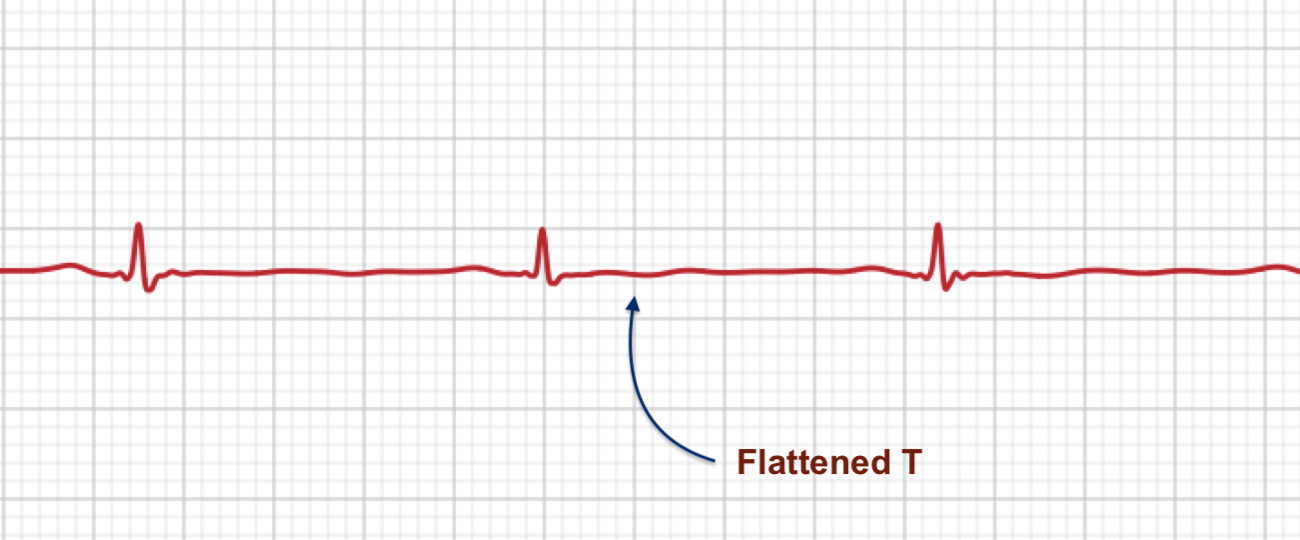
What causes a flattened T wave?
The most common cause is an electrolyte imbalance, particularly low potassium. Other causes include:
- Low potassium (hypokalaemia): the most frequent cause; potassium is essential for normal cardiac repolarisation
- Low magnesium: often accompanies low potassium and has a similar effect on the T wave
- Certain medications: diuretics, some antiarrhythmics, and other drugs that affect electrolyte balance
- Mild ischaemia: reduced blood flow to the heart can produce T wave flattening before more pronounced changes appear
- Normal variation: a low-amplitude T wave can be normal, particularly in certain leads or in some individuals
Will I feel anything?
Usually not. A flattened T wave is a quiet finding. If it is being caused by low potassium, you might notice muscle weakness, fatigue, or occasional cramping, but most people with mild electrolyte shifts feel nothing out of the ordinary.
Any symptoms you are experiencing come from the underlying cause, not from the T wave change itself.
Should I be concerned?
A flattened T wave by itself is a mild finding, and in many cases it resolves on its own or with simple dietary changes. It is worth mentioning to your doctor if:
- It appears consistently across multiple recordings
- You are on diuretics or other medications that affect electrolytes
- You have had recent illness with vomiting, diarrhoea, or poor fluid intake
- You notice muscle weakness, unusual fatigue, or cramps alongside it
- You have a known heart condition
In many cases, your doctor may simply check your potassium level with a blood test. If it is low, correcting it often resolves the T wave finding entirely.
A good next step
- Take a few more recordings to see if the finding is consistent or appears only occasionally.
- Consider your diet and medications: low potassium can come from diuretics, poor diet, or recent illness. Bananas, leafy greens, and legumes are good potassium sources.
- Share with your doctor: ECG+ lets you export a PDF report so your doctor can see the recording clearly and decide whether a blood test or further review is needed.
Frequently asked questions
Is a flattened T wave serious?
A flattened T wave is often caused by something correctable, such as low potassium or magnesium. It can also be a normal variant. Your doctor can determine whether anything needs attention based on your full clinical picture.
What causes a flat T wave?
The most common causes are electrolyte imbalances, particularly low potassium (hypokalaemia), as well as certain medications, mild ischaemia, and normal variation.
Can Apple Watch detect a flattened T wave?
The Apple Watch ECG app does not report T wave changes. ECG+ analyzes the waveform and flags a possible flattened T wave so you have something to bring to your doctor.