SVE on Apple Watch ECG: what it means and what to do
If ECG+ marked a possible SVE in your recording, take a breath. Supraventricular ectopic beats are one of the most common heartbeat variations found in healthy people. Most people who have them don't even feel them.
An SVE is simply a heartbeat that fires a little early from somewhere above the ventricles, the heart's lower chambers. Your heart resets itself naturally after each one, and normal rhythm resumes straight away.
SVE, PAC and PJC: one family of early beats
SVE stands for supraventricular ectopic beat: "supraventricular" means above the ventricles, and "ectopic" means the beat started somewhere other than the heart's natural pacemaker. It covers two kinds of early beat:
- PAC, a premature atrial contraction, which starts in the atria, the upper chambers
- PJC, a premature junctional contraction, which starts in the AV junction between the upper and lower chambers
Both travel down to the ventricles along the usual route, so on an ECG they look much the same. Telling them apart depends on the small P wave just before the beat, and on a single-lead watch ECG that wave is often too faint to judge reliably. Rather than guess, ECG+ names what it can see with confidence: the beat came early, and it started above the ventricles. Most SVEs are PACs, so your doctor may call the same beats PACs. If you'd like to read more about them, see our guide to PACs.
What does an SVE feel like?
Many people never feel them. When they are noticeable, an SVE typically feels like:
- A brief flutter or a skipped beat
- A slightly stronger beat immediately after the pause, the heart catching up
- An occasional brief awareness of your heartbeat
These sensations pass quickly and on their own are not a sign that something is wrong.
How ECG+ marks a possible SVE
On your Apple Watch ECG, an SVE shows up as a beat that arrives earlier than the surrounding rhythm, usually with a narrow shape much like your other beats. ECG+ marks each one with an  badge, the S stands for supraventricular, so you can see exactly where the premature beats occurred in your recording.
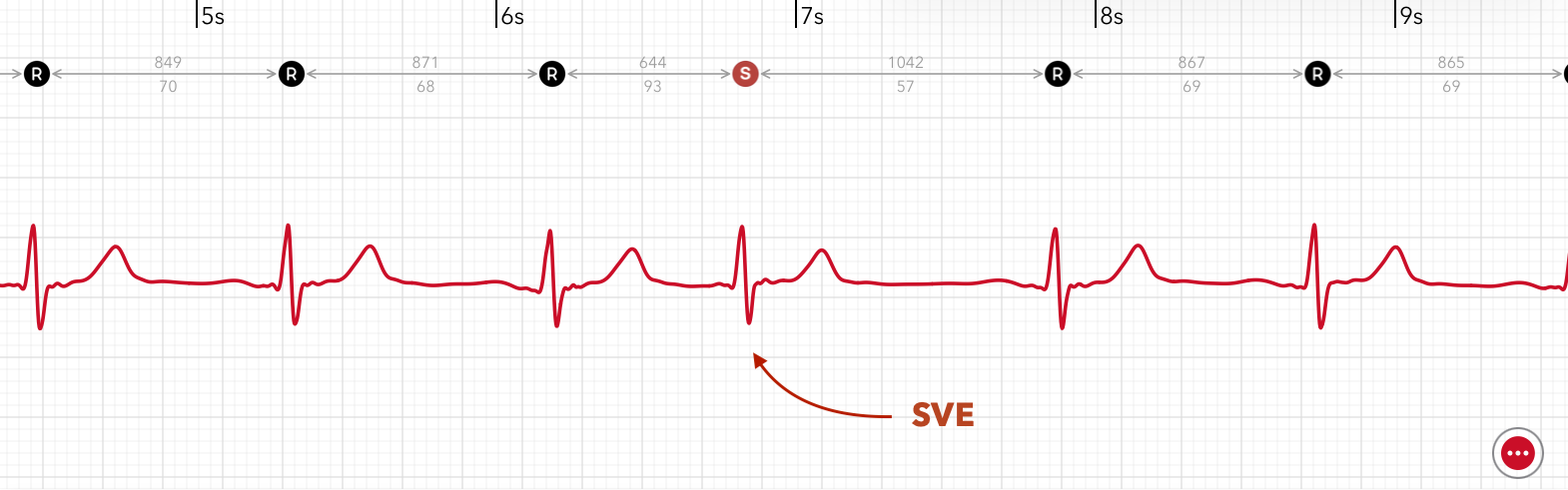
Here is another example, the early beat stands out clearly from the regular rhythm on either side:

SVE patterns you might see
Sometimes SVEs appear on their own, and sometimes they fall into a repeating pattern. ECG+ names these so you have the right words if you speak with a doctor:
ECG+ also calculates your SVE burden, the share of all beats that are SVEs, so you can track how things change across recordings over time.
SVE vs PVC, what is the difference?
Your ECG+ report may show both SVEs and PVCs, and it is worth understanding what sets them apart. Both are early beats, but they come from different parts of the heart.
An SVE starts above the ventricles, so the beat follows the heart's normal electrical pathway into the ventricles and looks relatively ordinary on the ECG. A PVC starts in the ventricles, the lower chambers, and travels a different electrical route, producing a wider, more prominent wave.
In practice, PVCs often feel more noticeable: that heavy thump is more pronounced because the pause after it is usually slightly longer. SVEs tend to be subtler. That said, neither is inherently more serious than the other for most people. ECG+ tracks them separately so you can see which type appears in your recordings and how often.
Things that can bring on SVEs
SVEs often have a direct cause, and identifying yours can be genuinely useful. Common triggers include:
- Caffeine, coffee, energy drinks, strong tea
- Poor sleep or fatigue
- Stress or anxiety
- Alcohol
- Dehydration
- Intense exercise, especially if you are not well rested
If you notice SVEs appearing after any of these, that pattern is worth noting and mentioning to your doctor.
Should I be concerned?
For most people, occasional SVEs need no treatment. It is always worth mentioning them to your doctor, particularly if they are happening often, if the pattern has changed, or if they come with dizziness or chest discomfort. Your doctor can advise whether anything further is needed, and in most cases, the answer is simply to monitor and keep an eye on things.
What ECG+ gives you is real data to bring to that conversation, rather than just a description of how you felt.
A good next step
- Take a few more recordings over the coming days to see whether SVEs appear consistently or only occasionally.
- Note any triggers: what you ate, drank, or were doing before recordings where SVEs appear.
- Share with your doctor: ECG+ lets you export your recordings as a PDF report, which gives your doctor something concrete to look at.
Frequently asked questions
Is an SVE the same as a PAC?
An SVE is the wider family a PAC belongs to. SVE covers any early beat that starts above the ventricles: PACs, which start in the atria, and PJCs, which start in the AV junction. Most SVEs are PACs, so your doctor may well call the same beats PACs.
Can Apple Watch detect SVEs?
The Apple Watch ECG app records a single-lead trace that can show supraventricular ectopic beats as early beats among the regular rhythm. The built-in app does not label them by name, but apps like ECG+ can analyze the recording and flag possible SVEs for you. When SVEs are frequent in a reading, the app may also return an inconclusive result, since the rhythm falls outside what it's designed to classify.
Are SVEs dangerous?
Occasional SVEs are very common and are usually harmless in people without heart disease. Frequent SVEs, or SVEs that cause symptoms, are worth discussing with a doctor, but on their own they are rarely dangerous.
Can SVEs turn into AFib?
A high number of early beats from the atria is associated with a higher chance of developing atrial fibrillation over time, but most people with occasional SVEs never develop AFib. If you have many SVEs, your doctor may want to monitor your heart rhythm more closely.