Why the P wave is missing on your Apple Watch ECG
The P wave is the small bump just before each heartbeat: the moment the atria, the heart's upper chambers, contract. On an Apple Watch recording it is often faint, and sometimes you simply cannot find it at all. That is unsettling, because in a textbook the P wave is always drawn right there.
In most cases this is a limit of what the watch can see, not evidence that your heart skipped the beat. But not always, and the difference genuinely matters.
The one line to remember: a P wave you can't see is not the same as a P wave that isn't there.
Truly absent P waves are a hallmark of rhythms like atrial fibrillation. Faint or invisible P waves are also completely routine on a watch recording. Telling those two apart is a job for a clinician, not for you and not for the watch, so if the P waves look absent, show the recording to your doctor rather than deciding either way yourself.
The P wave is the easiest thing on the ECG to lose
Every part of the heartbeat is not created equal in size. The P wave is the smallest deflection on the whole tracing, normally under 0.25 mV (about 2.5 small squares). The R spike beside it can be ten to twenty times taller.
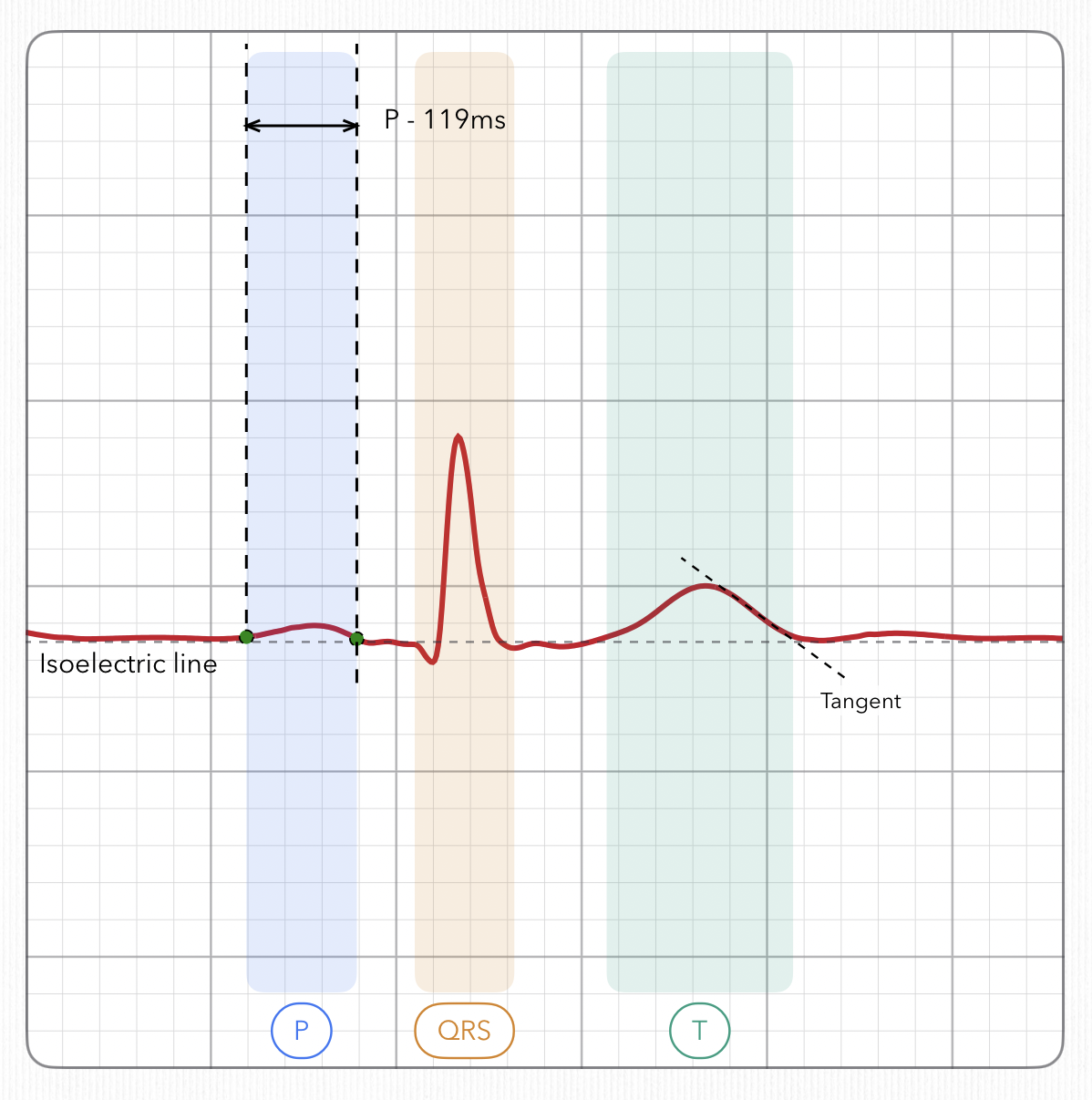
That size difference is the whole story. Any noise floor that a big R spike shrugs off will swallow a P wave completely. So when a recording is even slightly imperfect, the P wave is the first casualty, long before anything else becomes hard to read.
Apple Watch records Lead I, the worst lead for P waves
This is the part most people never hear, and it explains a lot.
A lead is just a viewing angle on the heart. During normal sinus rhythm the atrial impulse travels down and to the left, giving the P wave an electrical axis of roughly 60°. The size of any wave on a given lead depends on how closely aligned the wave is with that lead's angle: line them up and you get the tallest possible signal; sit at right angles and you get almost nothing.
- Lead II sits at +60°, essentially straight down the atrial axis. That is why Lead II is the classic lead for reading P waves and why the P wave is reliably upright and clear there.
- Lead I sits at 0°, about 60° away from the atrial axis. The same P wave projects onto it much smaller.
- The Apple Watch records Lead I, worn on the wrist with a finger on the Digital Crown. So it is showing you the P wave from the least favourable angle available.
A hospital ECG hides this problem, because it records twelve leads at once. If the P wave is unconvincing in one lead, the reader simply looks at Lead II or V1, where atrial activity shows up best. With a single-lead recording there is no second opinion to fall back on: if the P wave is small in Lead I, that's all you get.
You can actually borrow Lead II. By holding the watch against your lower-left abdomen or ankle with a right-hand finger on the Crown, you record a tracing that corresponds to Lead II, where P waves are usually far clearer.
See how to record a Lead II ECG on Apple Watch, including the safety caveats, since the watch's automatic rhythm result does not apply in that position.
Dry contacts, not the clinic's gel electrodes
The second reason is physical. In a clinic, the technician preps your skin and applies wet gel electrodes. The gel soaks into the outer layer of skin and creates an ionic bridge to the tissue underneath, which drops the electrical resistance between skin and electrode dramatically and holds it steady.
The Apple Watch has no gel. It uses two dry electrodes: the back crystal against your wrist and the Digital Crown under a fingertip. Dry skin contact typically sits somewhere around 500 kΩ to 1 MΩ across the ECG frequency band, far higher than a prepped gel electrode, and it drifts as you move, sweat or press differently.
Higher and less stable contact resistance means a higher noise floor and more distortion of the smallest signals. The QRS spike is large enough to survive that comfortably. The P wave, an order of magnitude smaller, often does not. On top of that, the filtering used to flatten baseline wander works on low frequencies, which is exactly where the slow, rounded P wave lives, so aggressive filtering can flatten it further.
None of this is a fault in the watch. It is the honest trade of a 30-second reading you can take anywhere, on your wrist, against a prepared ten-electrode setup in a clinic.
When the P wave is genuinely not identifiable
Sometimes the P wave really is absent or unreadable, and these are the situations a doctor is looking for. This list is for understanding, not for self-diagnosis:
- Atrial fibrillation: organized atrial activity is replaced by chaotic fibrillatory waves, so there are no true P waves, usually alongside an irregular rhythm.
- Atrial flutter: P waves are replaced by a regular sawtooth pattern of flutter waves.
- Junctional rhythms: the beat starts below the atria, so the P wave can be absent, inverted, or hidden inside the QRS complex.
- A fast heart rate: as the rate climbs, the P wave slides into the preceding T wave and becomes impossible to separate.
- Premature atrial beats: the early P of a PAC often lands on top of the previous T wave and hides there.
- Sinus arrest or sinoatrial block: the atrial impulse does not fire or does not conduct, so the P wave is genuinely missing for a beat.
- Marked electrolyte abnormalities, such as high potassium, which can flatten P waves progressively.
Notice that several of these come with other clues, an irregular rhythm, a very fast rate, a sawtooth baseline. That context is a large part of how a clinician distinguishes "absent" from "too small to see", and it is why the whole recording matters, not just the missing bump.
How to give the P wave its best chance
- Dry everything first. A damp wrist or fingertip raises contact resistance further, and the P wave pays for it. See how to get clean recordings every time.
- Rest your forearm and stay still. Muscle noise and baseline drift bury small waves before large ones.
- Sit quietly and breathe normally for the full 30 seconds, and don't talk.
- Try a Lead II position if you want the best possible look at atrial activity, using the placement described above.
- Record more than once. P-wave visibility varies between recordings far more than people expect.
Bring the recording, not a conclusion. If your P waves look absent, the useful next step is to hand a clean recording to your doctor and let them read it in context.
ECG+ re-analyzes your Apple Watch recordings and marks what the standard app doesn't, PACs, PVCs, bigeminy, QT/QTc and HRV, on a clear, printable report you can hand over.
Frequently asked questions
Why can't I see the P wave on my Apple Watch ECG?
Usually because of how the watch records, not because the P wave is absent. The P wave is the smallest part of the heartbeat, normally under 0.25 mV, while the R spike can be ten to twenty times larger. The Apple Watch records a single Lead I through two dry electrodes, and Lead I is the lead where the P wave is naturally smallest. Add any noise and the P wave is the first thing to disappear.
Does a missing P wave mean I have atrial fibrillation?
Not on its own. In atrial fibrillation the P waves really are replaced by irregular fibrillatory activity, so absent P waves are one of its hallmarks. But on a watch recording, a P wave you cannot see is far more often faint than truly absent. The difference matters and isn't something to judge yourself: if the P waves look absent, or the rhythm is irregular, show the recording to a doctor.
How can I get a clearer P wave on Apple Watch?
Take the cleanest possible recording: dry the contacts, rest your arm, and stay still, since baseline wander and muscle noise bury small waves first. You can also record a Lead II style tracing by holding the watch against your lower-left abdomen or ankle with a right-hand finger on the Digital Crown. Lead II runs along the atrial axis, so the P wave is usually much clearer there.