Inverted T wave on Apple Watch ECG: what it means
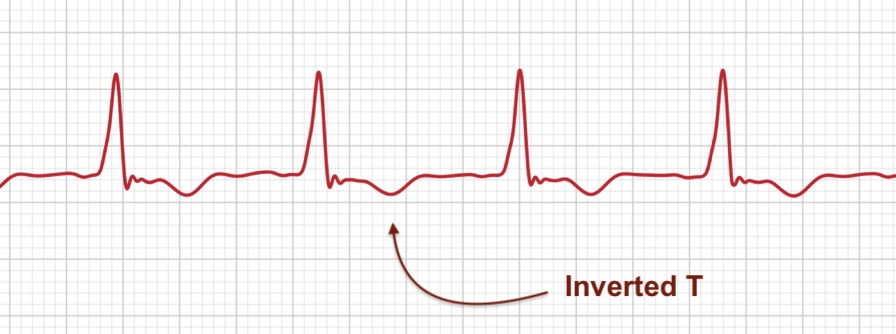
If ECG+ flagged an inverted T wave in your recording, it means the T wave in your ECG is pointing downward rather than up. A normal T wave curves gently upward: it represents your heart muscle recovering after each beat. When it flips, that recovery looks different to the usual pattern.
T wave inversion has many possible causes, ranging from completely benign to worth checking. On its own, it is not a diagnosis: it is a signal that something about the recovery phase of your heartbeat looks different, and it is worth knowing about.
What does the T wave do?
Each heartbeat on an ECG is made up of several waves. The large spike in the middle, the QRS complex, represents the main contraction. The T wave that follows represents ventricular repolarisation: the moment your heart muscle resets and recharges for the next beat.
In a typical ECG, the T wave points in the same direction as the main QRS spike, upward, with a rounded shape. When it inverts, it points the opposite way.
What causes T wave inversion?
There are several reasons a T wave might invert. The most common one for Apple Watch users is worth checking first:
- Wrist setting doesn't match which wrist you're wearing the watch on: this is the most frequent cause for Apple Watch users. When you set up Apple Watch, it asks which wrist you wear it on. If that setting doesn't match reality, for example, the setting says Left but you actually wear it on your right, the ECG signal is recorded with reversed polarity, which flips the entire waveform including the T wave. Check your Apple Watch wrist setting in the Watch app under General → Watch Orientation, and make sure it matches the wrist you actually wear it on.
- Reduced blood flow to the heart: ischaemia is one of the more common clinical causes; the heart muscle under stress repolarises differently
- Right ventricular strain: from conditions like pulmonary embolism or chronic lung disease
- Bundle branch block: a delay in the electrical pathway that changes the whole waveform shape
- Electrolyte imbalances: low potassium or magnesium can alter repolarisation
- Certain medications: some cardiac and psychiatric drugs affect the T wave
- Normal variant: T wave inversion in certain leads can be normal, particularly in women, athletes, and in children
Will I feel anything?
Often, no. T wave inversion is a waveform finding, not a symptom in itself. Whether you feel anything depends entirely on the underlying cause. Many people whose ECG shows T wave inversion have no symptoms at all. Others may have chest discomfort, fatigue, or shortness of breath, but those symptoms would be coming from an underlying condition, not from the T wave inversion itself.
Should I be concerned?
A single finding of T wave inversion, especially without symptoms, is something to be aware of rather than alarmed by. That said, it is the kind of finding that is worth mentioning to your doctor, particularly if:
- It appears in multiple recordings and seems consistent
- You have any chest discomfort, pain, shortness of breath, or dizziness
- It is new: you did not see it in earlier recordings
- You have a known heart condition or family history of cardiac events
Your doctor can put the finding in context and decide whether anything further is needed. In many cases, no follow-up is required at all.
A good next step
- Take a few more recordings over the coming days to see whether the inversion is consistent or appears only occasionally.
- Note any symptoms: even mild ones like unusual fatigue or chest tightness, and when they occur relative to your recordings.
- Share with your doctor: ECG+ lets you export a PDF report, giving your doctor something concrete to review alongside your history.
Frequently asked questions
Is an inverted T wave dangerous?
Not always. T wave inversion has many causes, from completely benign variants to conditions that need attention. On its own, it is not a diagnosis, your doctor will look at the clinical picture together with your ECG.
What causes T wave inversion?
Common causes include reduced blood flow to the heart, right ventricular strain, bundle branch block, electrolyte imbalances, and certain medications. It can also be a normal variant in some leads.
Can Apple Watch detect T wave inversion?
The Apple Watch ECG app does not report T wave changes. ECG+ analyzes the waveform shape and flags T wave inversion so you can discuss it with your doctor.