What "inconclusive" means on Apple Watch ECG: and how to fix it
An inconclusive result means the Apple Watch ECG app couldn't confidently sort your recording into one of its categories. It doesn't mean something is wrong with your heart, but it doesn't mean nothing is, either. Here's what the label actually means, why it happens, how to get a clearer reading, and what an inconclusive recording can still hide.
What "inconclusive" actually means
The Apple Watch ECG app sorts each 30-second recording into a small set of results: sinus rhythm, atrial fibrillation (AFib), high heart rate, low heart rate, poor recording, and inconclusive. "Inconclusive" simply means the recording didn't fit any of those categories clearly enough for the algorithm to classify it.
Importantly, the app is only designed to look for a few specific things, mainly whether the rhythm looks like normal sinus rhythm or AFib. Anything outside that narrow scope can land in the inconclusive bucket.
A leading reason: extra or irregular beats
One of the most common reasons for an inconclusive result is that your recording contains something the ECG app simply isn't built to classify. The app is designed to do one job well, decide whether your rhythm looks like normal sinus rhythm or atrial fibrillation. It doesn't set out to identify any other pattern.
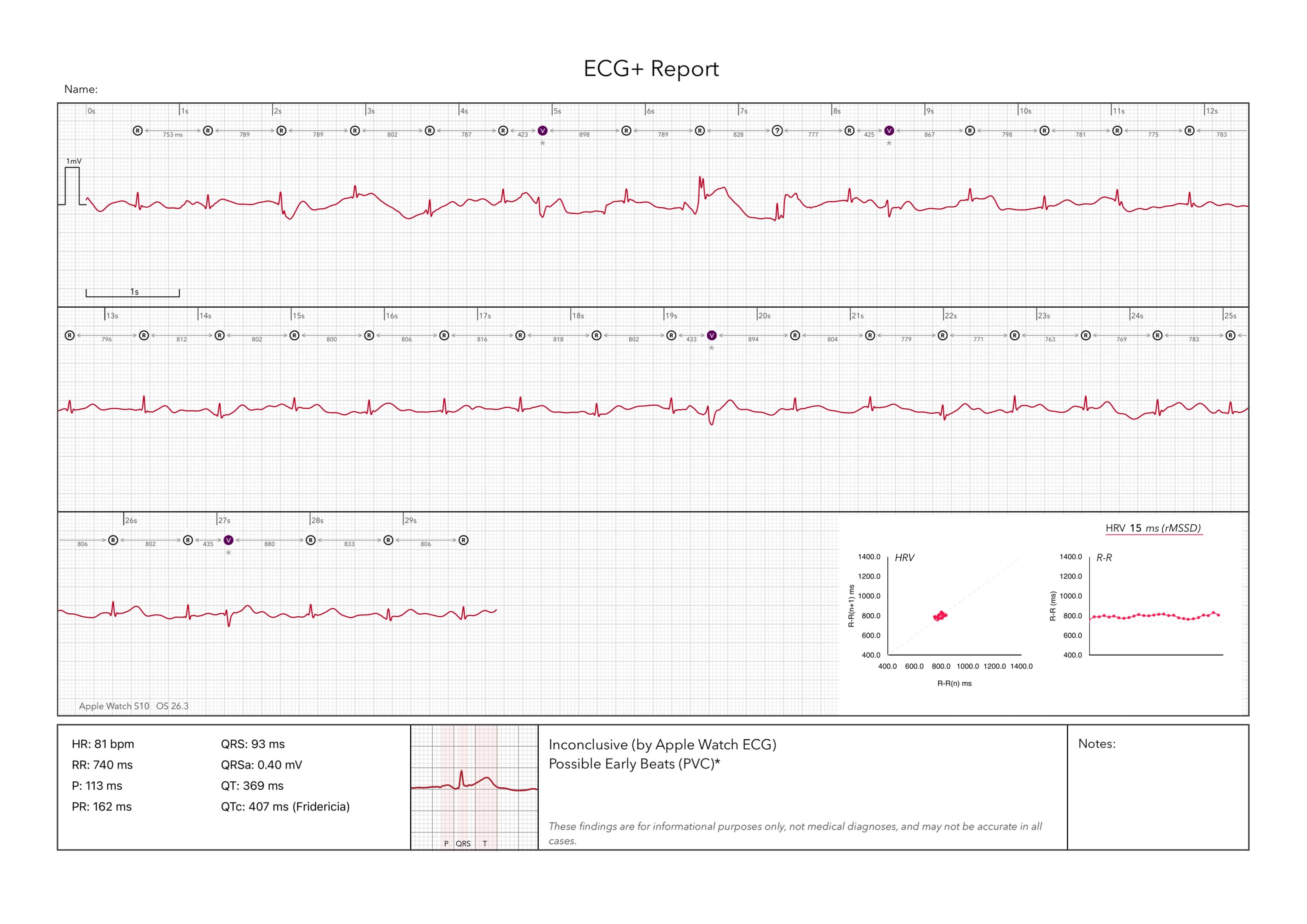
So when a recording includes frequent extra beats, such as repeated premature atrial contractions (PACs) or premature ventricular contractions (PVCs), or another rhythm that sits outside its narrow scope, it often can't place the recording in either category and returns inconclusive instead. In other words, an inconclusive result can mean there is something noticeable in the recording, just not the specific thing the app is designed to look for.
Other common reasons for an inconclusive result
- Heart rate below 50 or above 120 bpm during the reading, outside this range the app can't classify the rhythm.
- A noisy or low-quality recording from movement or a loose watch.
- Wearing the watch too loosely, so the sensors lose good skin contact.
- A pacemaker or ICD, which the ECG app does not assess.
- Some physiological differences in how individual hearts produce the signal.
How to get a clearer reading
- Rest your forearm on a table or in your lap so it's fully supported.
- Make the band snug: not loose, not painfully tight.
- Stay completely still and don't talk during the 30 seconds.
- Take it when your heart rate is settled, not right after exercise or stress, so it sits within the 50–120 bpm range.
- Make sure skin is clean and not too dry for good sensor contact.
- Try again: a single inconclusive reading is often just a one-off.
An inconclusive label isn't a dead end. "Inconclusive" only means the ECG app couldn't fit the recording into one of its categories, but the full waveform is still recorded and saved, including any extra beats it contains.
ECG+ can analyze that same raw recording and describe features the Apple Watch ECG app isn't designed to label, premature beats (PACs and PVCs), bigeminy, QT/QTc and more, giving you something concrete to take to your doctor.
When to see a doctor
An occasional inconclusive result is normal. But if you keep getting inconclusive readings, or you have symptoms such as palpitations, dizziness, chest discomfort or fainting, share your recordings with a doctor. The saved waveform, even from an inconclusive reading, can still be clinically useful, and ECG+ makes it easy to export a clean PDF to bring along.
Frequently asked questions
Is an inconclusive Apple Watch ECG bad?
Not by itself. Inconclusive simply means the ECG app could not sort the recording into one of its categories. It is commonly caused by a heart rate under 50 or over 120 bpm, or by a noisy recording, not necessarily by a heart problem.
Why does my Apple Watch ECG always say inconclusive?
Repeated inconclusive results often mean your heart rate is consistently outside the 50–120 bpm range the app needs, the recording is persistently noisy, or your recording contains a pattern the app isn't designed to classify, such as frequent premature beats (PACs or PVCs). Improving how you take the reading helps; persistent results are worth discussing with a doctor.
Can I still use an inconclusive recording?
Yes. The full waveform is still saved even when the result is inconclusive. A doctor can review it, and apps like ECG+ can analyze the same raw recording to identify features such as premature beats or QT timing that the inconclusive label does not describe.