Baseline wander on Apple Watch ECG
If your Apple Watch ECG trace seems to drift up and down, wandering away from the flat line it should sit on: you're seeing baseline wander. It's one of the most common recording artifacts on a single-lead ECG, and the good news is that it's almost always about how the recording was taken, not about your heart. Here's what causes it, why it matters, and how to get a clean, steady trace.
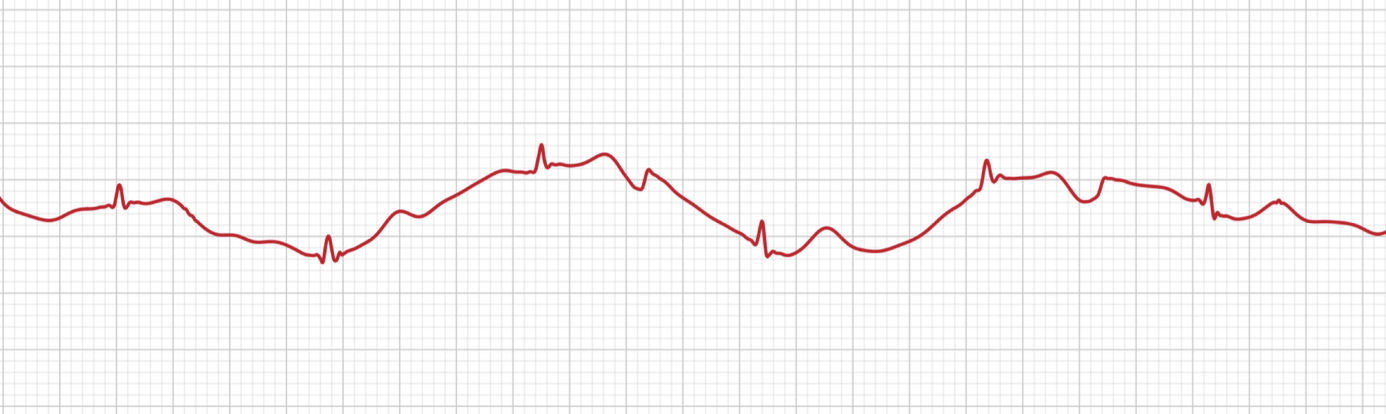
Baseline wander: the whole trace slowly drifts away from the isoelectric line, making the PQRST waves harder to read.
What is baseline wander?
Baseline wander is a slow, low-frequency drift that pulls the ECG trace up and down away from the isoelectric line: the flat baseline the signal should return to between beats. The heartbeat itself is still there, but it rides on a moving floor, which makes the waveform look unstable and can make it harder to identify important features like the P, Q, R, S and T waves.
What causes it
- Movement and poor contact: adjusting your position, talking, or losing steady contact between your finger and the Digital Crown all shift the baseline.
- Breathing: the watch moves slightly with each breath, especially deep breaths, nudging the baseline up and down.
- A loose watch: a band that's too loose gives inconsistent skin contact, which shows up as drift.
- Electrical interference: the Apple Watch minimizes this, but nearby electrical sources can still cause minor shifts.
Why it matters
Baseline wander can obscure the PQRST waves that matter for reading heart rhythm. When the baseline isn't stable, subtle details, like ST-segment shifts or T-wave changes, are harder to judge accurately. A heavily wandering trace doesn't mean anything is wrong with your heart, but it can make a recording less useful, so it's worth taking a steadier one.
How to reduce it
- Rest your arm on a table or your lap so it isn't holding itself up.
- Stay still and quiet for the full 30 seconds, no talking, minimal movement.
- Wear the watch snug on a dry wrist for consistent contact.
- Hold a steady finger on the Digital Crown without pressing too hard or shifting.
How ECG+ handles baseline wander
ECG+ applies digital signal-processing filters that correct for low-frequency drift while preserving the essential shape of the waveform: so a recording with mild wander can still be read clearly. That filtering can't rescue every trace, though. If a recording wanders heavily, the cleanest fix is to take another one using the tips above. If your watch keeps returning unreadable results, see our guides on a "poor recording" and an "inconclusive" result.
Frequently asked questions
What is baseline wander on an ECG?
Baseline wander is a recording artifact where the ECG trace slowly drifts up and down away from the flat baseline (the isoelectric line). It's usually caused by movement, breathing or loose skin contact, not by your heart itself.
Does baseline wander mean something is wrong with my heart?
No. Baseline wander is a signal-quality issue, not a heart problem. It can obscure real features of the trace, though, so it's worth taking a steadier recording before reading too much into one that wanders heavily.
How do I stop my Apple Watch ECG from drifting?
Rest your arm on a stable surface, keep still and quiet during the 30 seconds, make sure your wrist is dry and the watch is snug, and hold a steady finger on the Digital Crown without pressing too hard.