QT interval & the U wave on Apple Watch ECG
Measuring the QT interval means knowing exactly where the T wave ends, and a U wave can make that harder. The U wave is a small deflection that sometimes appears just after the T wave, and when the two run together it can be unclear where one stops and the other begins.
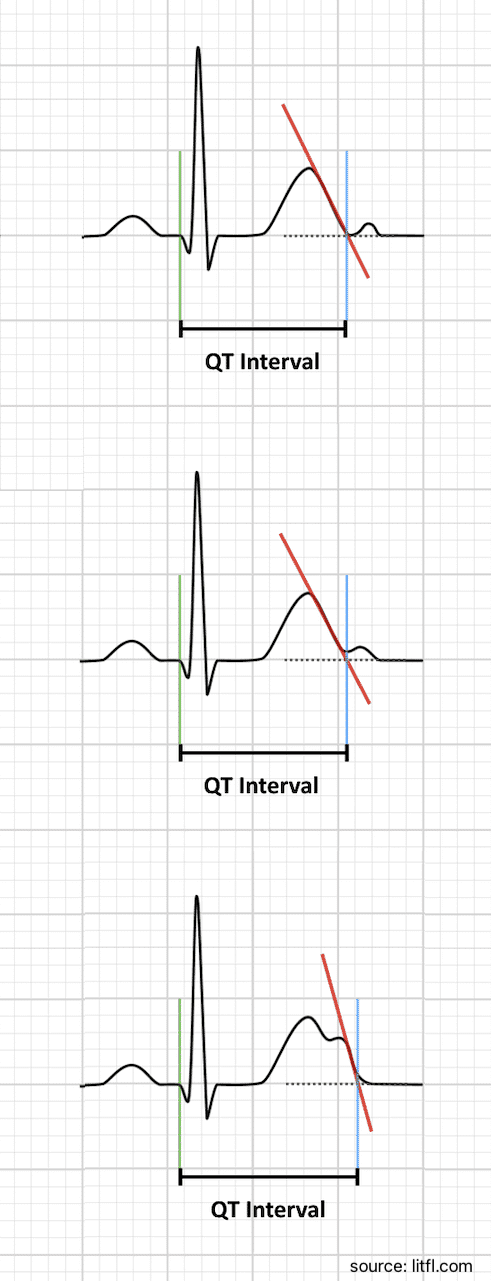
Where the T wave ends, and whether to include a U wave, affects the QT measurement. Image source: litfl.com.
When to include the U wave
The presence of a U wave complicates measurement of the QT interval, because it may be unclear where the T wave ends and whether the U wave should be counted. The general rule:
- Include large U waves (greater than 1 mm) that are fused to the T wave.
- Exclude smaller U waves, and any U wave that is clearly separate from the T wave.
Why it matters
Getting the end of the T wave right is what makes a QT, and therefore a heart-rate-corrected QTc, accurate. Including a separate U wave by mistake can make the QT look longer than it is. On a single-lead Apple Watch ECG, prominent U waves are one of several reasons a QT measurement should be interpreted with care and confirmed by a clinician when it matters.
Frequently asked questions
What is a U wave on an ECG?
The U wave is a small deflection that can appear just after the T wave. It's often subtle, and its presence can make it harder to judge exactly where the T wave ends, which matters when measuring the QT interval.
Should the U wave be included in the QT interval?
Generally, large U waves (greater than 1 mm) that are fused to the T wave should be included in the measurement, while smaller U waves and those clearly separate from the T wave should be excluded.